
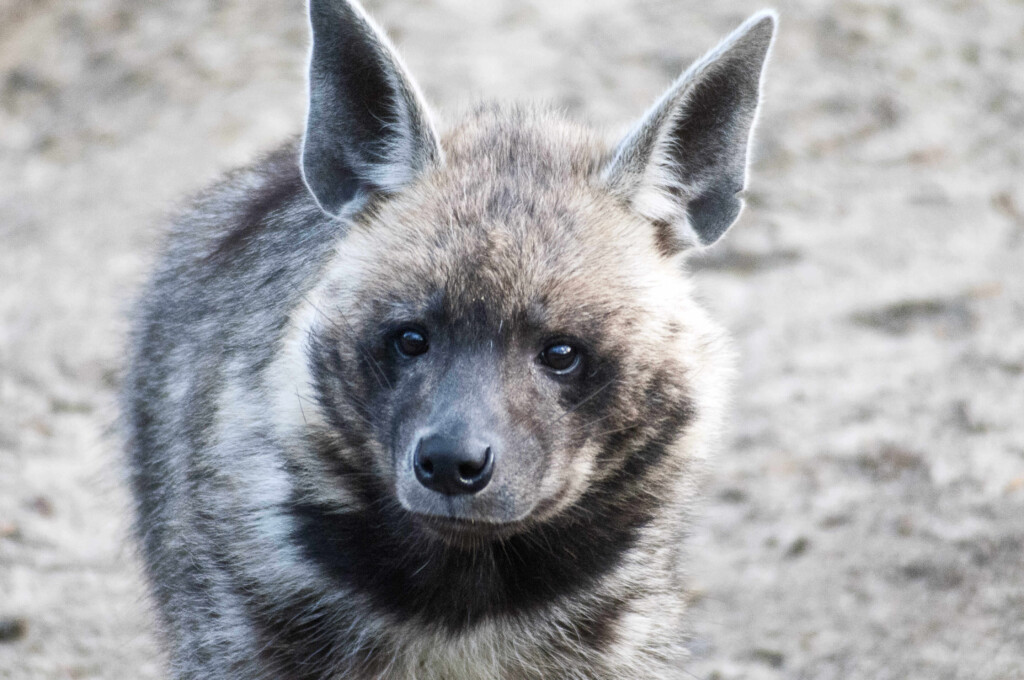
Striped hyena
Hyaena hyaena
The striped hyena has a relatively large but fragmented range, extending across northern and northeastern Africa, the Middle East, the Arabian Peninsula, Central Asia, and India.
Full Classification
Class – Mammalia
Order – Carnivora
Family – Hyaenidae
Genus – Hyaena
Species – Hyaena hyaena
General Information
The striped hyena has a relatively large but fragmented range, extending across northern and northeastern Africa, the Middle East, the Arabian Peninsula, Central Asia, and India. It inhabits dry, hilly regions covered with shrubs. For dens, striped hyenas often choose rocky hills, ravines, and crevices. They can also be found in open savanna habitats.
The striped hyena is a medium-sized carnivore with a dog-like appearance, weighing approximately 20–40 kg. Its coat is pale grey or beige, with a black patch on the throat, 5–9 vertical stripes on the sides of the body, and more distinct black transverse stripes on the forelegs and hind legs. A distinctive mane runs along the dorsal line of the body, while the tail is long and bushy. The body length is approximately 100–115 cm, and the height at the shoulder is 60–75 cm. Striped hyenas can live for approximately 17–20 years.
Striped hyenas are generally solitary animals, although they have a certain degree of social organisation. They usually forage alone and are rarely seen in groups. However, they may occasionally form small family groups around a den. The mother begins bringing food to the den when the cubs are about one month old and continues to care for and feed them for up to a year. A female usually gives birth to 1–4 cubs, and pregnancy lasts approximately 2.5–3 months.
The striped hyena is an omnivorous species, although carrion forms the main part of its diet. It feeds on the remains of animals such as zebras, wildebeest, gazelles, and other mammals. Hyenas are capable of consuming bones from carcasses when little or no meat remains. They may also feed on human refuse and supplement their diet with fruits, insects, and occasionally small animals such as hares, rodents, reptiles, and birds. Striped hyenas are predominantly nocturnal.
What are the main threats to striped hyenas?
- Human–hyena conflict, particularly in regions where livestock farming is widespread;
- Loss of natural habitats.
The conservation status of the species on the IUCN Red List of Threatened Species™ is Near Threatened (NT).
The striped hyena is protected under Appendix III of CITES (the Convention on International Trade in Endangered Species of Wild Fauna and Flora).
5 Interesting facts
- The striped hyena is often thought of as exclusively a scavenger, but it is actually an omnivorous animal. In addition to carrion, it may eat insects, fruits, small mammals, birds, and reptiles.
- Striped hyenas have powerful jaws and strong teeth that allow them to crack and digest bones. This enables them to make use of parts of a carcass that are inaccessible to many other predators.
- A long mane runs along the striped hyena’s back. When the animal is frightened or excited, the mane can stand upright, making the hyena appear much larger than it really is.
- The striped hyena’s distinctive dark markings are one of the species’ most recognisable features. The stripes are particularly prominent on the legs and sides of the body and help distinguish it from other hyena species.
- The striped hyena is primarily nocturnal. It becomes active around dusk and at night, using its well-developed sense of smell and hearing to navigate and locate food, including prey and carrion.
Інші мешканці
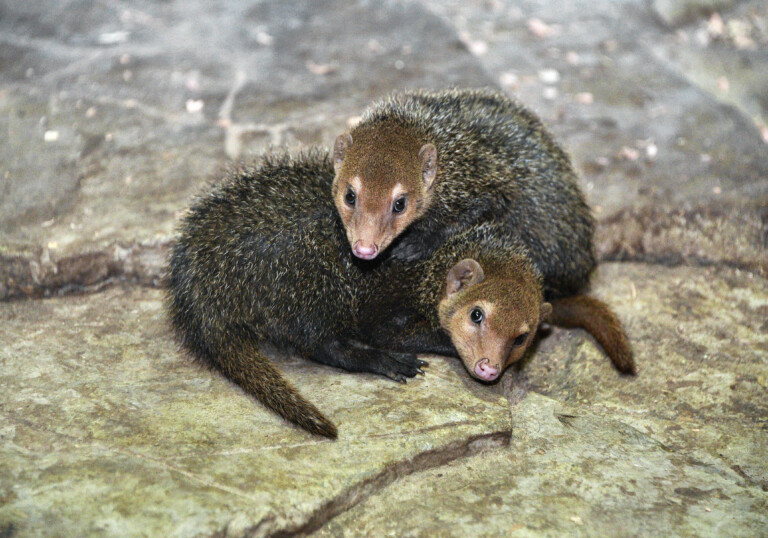
Common cusimanse
COMMON CUSIMANSE
The common cusimanse is a species native to West Africa, including Ghana, Côte d’Ivoire, Liberia,...
Детальніше
