TEXAS RAT SNAKE
Type: Chordates (Chordata)
Class: Reptiles (Reptilia)
Order: Squamata
Family: Colubridae
Genus: Pantherophis
Species: Pantherophis obsoletus
Form: Leucistic
The Texas Rat Snake (Pantherophis obsoletus), also known as the Western Rat Snake, is native to the central and southern regions of the United States – particularly Texas, Louisiana, Oklahoma, Arkansas, and Missouri. It inhabits forests, grasslands, wetlands, and rural areas near human settlements. The leucistic form is rarer and is characterized by a white or cream-colored body with dark eyes, unlike albino individuals that have red eyes.
Lifespan in the wild, the species lives for about 10–15 years, while in captivity it can reach up to 20 years with proper care. Adult snakes usually weigh between 0.5 and 1 kg. The body length ranges from 120 to 180 cm, occasionally reaching up to 2 meters. Texas Rat Snakes are solitary and mainly diurnal reptiles. They are excellent climbers and can often be seen on trees or even buildings while searching for prey. Females lay 6–20 eggs in shaded or protected areas, and the incubation period lasts 50–70 days. Hatchlings are fully independent from birth. This species is carnivorous, feeding primarily on small mammals (especially rats and mice), bird eggs, nestlings, and occasionally small reptiles. It plays an important ecological role as a natural controller of rodent populations.
The genus Pantherophis belongs to an ancient group of non-venomous snakes that appeared in North America during the late Miocene, around 10–12 million years ago. Modern subspecies evolved due to climatic shifts and habitat diversification across the continent.
Texas Rat Snakes are valuable allies in agriculture due to their ability to reduce rodent populations. Although they may appear intimidating, they are non-venomous and harmless to humans.
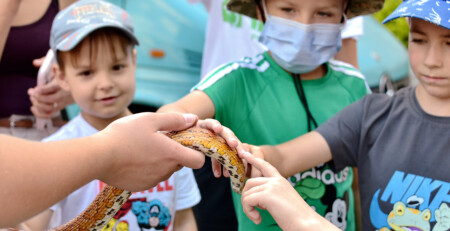
The leucistic form is particularly prized in herpetoculture and educational displays for its striking white coloration and calm temperament.
According to the IUCN Red List, the Texas Rat Snake is classified as “Least Concern”. The species is common throughout most of its range, though local populations may be affected by habitat destruction and road mortality.
5 Interesting Facts:
- The leucistic Texas Rat Snake lacks pigment in its skin but retains dark eyes – unlike albinos, which have red eyes.
- Despite its impressive size, it is calm, non-aggressive, and easily tamed in captivity.
- When threatened, it vibrates its tail rapidly, mimicking a rattlesnake to scare predators.
- This species is often kept in zoos and terrariums for educational demonstrations due to its docile nature.
- Juveniles have gray bodies with dark blotches that fade as they grow, becoming lighter with age.