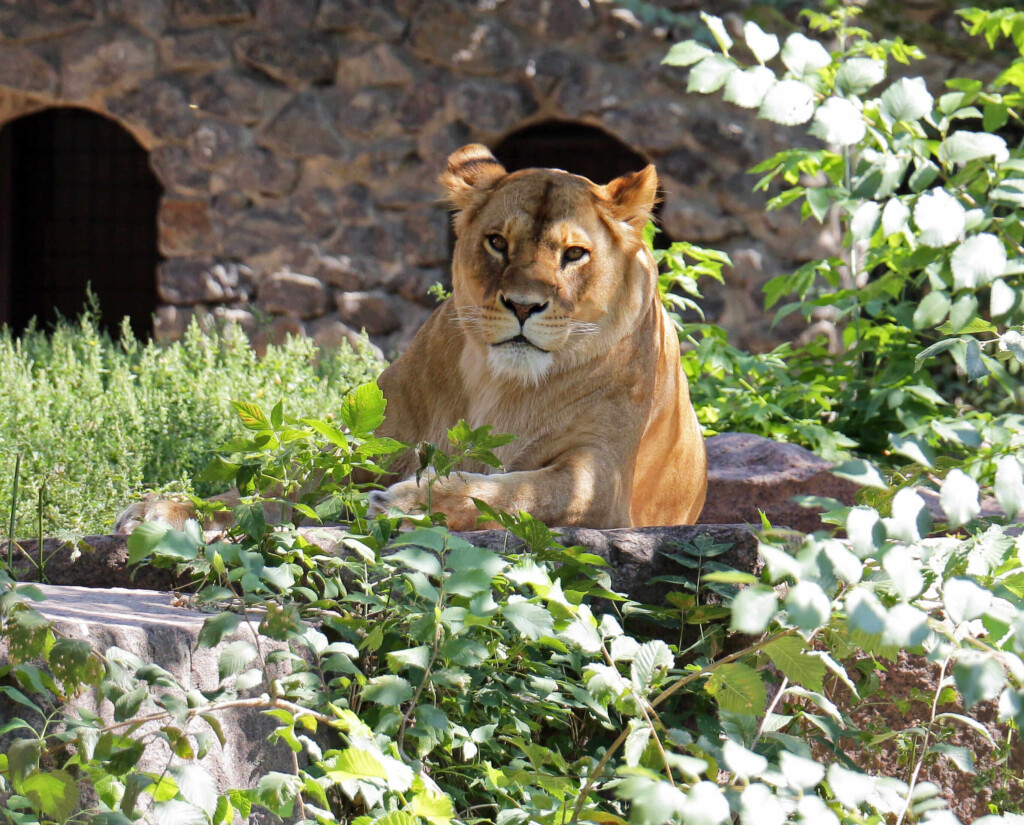
African lion
AFRICAN LION
Субекваторіальний пояс Африканського континенту.
Class – Mammalia (Mammals)
Order – Carnivora (Carnivores)
Family – Felidae (Cats)
Subfamily – Pantherinae (Big cats)
Genus – Panthera
Species – Panthera leo
The natural habitat of the African lion is the savanna — an ecosystem characterized by dense grass cover and scattered large trees or shrubs, which occupies much of the subequatorial belt of the African continent. Interestingly, the closest relative of the African lion is the Asiatic lion (Panthera leo persica), which survives in the wild only in Gir National Park in India.
An adult male lion weighs between 150 and 225 kg, while females weigh 100–150 kg. Body length ranges from 170 to 250 cm, while the tail can reach 90–110 cm in length. Lions exhibit pronounced sexual dimorphism: males are distinguished from females by their large mane.
Lions are the only representatives of the subfamily Pantherinae that live in family groups known as prides. A pride usually consists of several males (typically 1–2), several females (on average 7–8), and their offspring. The gestation period lasts approximately 3–4.5 months, after which the lioness gives birth to 1–6 cubs in a secluded and safe location. When the cubs reach about two months of age, the female returns to the pride with her offspring. Lions can live for approximately 13–20 years.
Lions are most active at night. Within a pride, females generally do most of the hunting, while males primarily protect the territory. The lion’s diet consists mainly of large ungulates, but during difficult times, lions may feed on a wide range of prey and may also consume carrion.
What are the main threats to African lions?
- Urbanization and agricultural expansion, which result in the destruction and fragmentation of the lion’s natural habitat.
- Habitat loss forces lions to prey on livestock belonging to local communities, increasing the likelihood of human–lion conflict.
- Poaching for the illegal trade in lion body parts.
- Climate change intensifies natural disasters such as droughts, floods, and storms, which can contribute to the decline and isolation of lion populations.
According to the latest scientific estimates, approximately 23,000–40,000 lions remain in the wild. Panthera leo is listed on the IUCN Red List of Threatened Species™ as Vulnerable (VU).
The African lion is protected under:
- Appendix II of the CITES Convention (Convention on International Trade in Endangered Species of Wild Fauna and Flora);
- Appendix II of the Bonn Convention (Convention on the Conservation of Migratory Species of Wild Animals).