
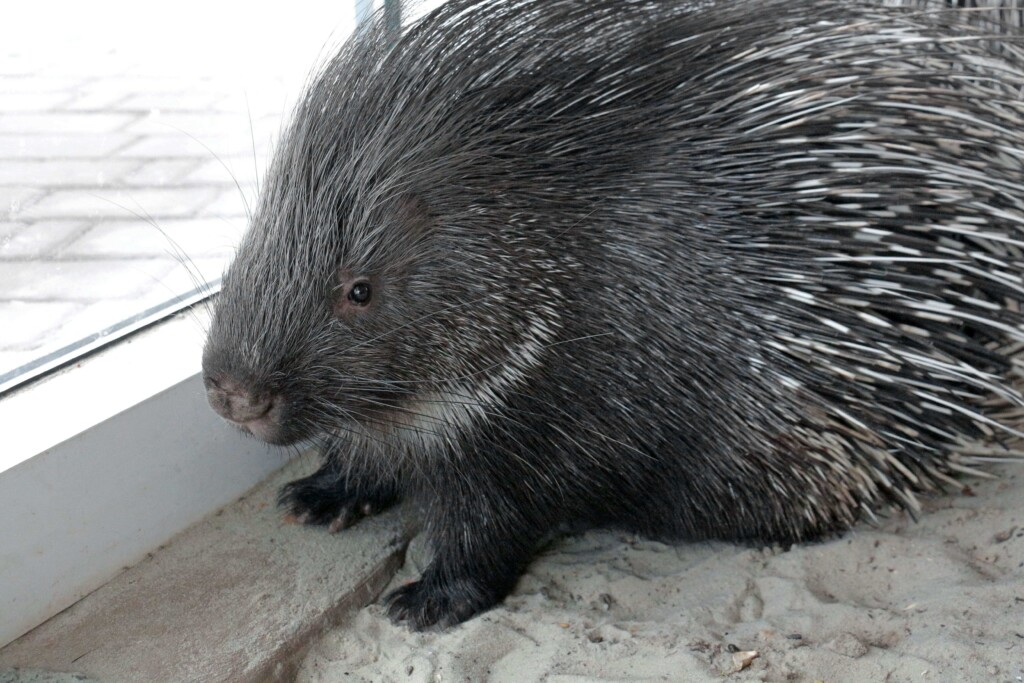
Indian crested porcupine
Hystrix indica
The Indian crested porcupine is distributed across South and Central Asia and parts of the Middle East, including countries such as India, Nepal, Bhutan, Bangladesh, Sri Lanka, Pakistan, Israel, Iran, and Saudi Arabia.
Full Classification:
Class – Mammalia (Mammals)
Order – Rodentia (Rodents)
Family – Hystricidae (Old World Porcupines)
Genus – Hystrix (Porcupines)
Species – Hystrix indica
General Information:
The Indian crested porcupine is distributed across South and Central Asia and parts of the Middle East, including countries such as India, Nepal, Bhutan, Bangladesh, Sri Lanka, Pakistan, Israel, Iran, and Saudi Arabia.
It is well adapted to a variety of environments, although it generally prefers rocky hills. The species can also be found in tropical and temperate shrublands, grasslands, and forests. Indian crested porcupines also inhabit the Himalayan Mountains, where they occur at elevations of up to 2,400 metres.
The average body length is 70–90 cm, with a tail measuring 8–10 cm. Instead of fur, the body is covered with quills of different lengths, which are brown or black with white bands. The longest quills measure approximately 15–30 cm and are located around the neck and shoulders. These quills provide the porcupine with effective protection against predators. The animal has long claws, which it uses for digging. Like all rodents, porcupines have incisors that grow continuously throughout their lives, meaning that they need to gnaw on objects and hard food to keep their teeth worn down. Their body weight ranges from 10 to 20 kg.
Porcupines are solitary, nocturnal animals that live in burrows which they dig themselves. Their lifespan is approximately 10–20 years. Females give birth to 1–4 young after a gestation period of 3–4 months. At birth, the young are covered with short, soft quills. Indian crested porcupines are generally considered monogamous, and both parents may remain in the burrow with their offspring throughout the year. They feed mainly on plant matter, including roots, grains, and fruits.
Local people often hunt porcupines for food.
5 Interesting Facts:
1. The quills of the Indian crested porcupine are actually modified hairs.
They are covered with a thick layer of keratin. The longest quills can reach approximately 30–50 cm. They are not venomous, but can detach easily upon contact with a predator and cause serious injuries.
2. Porcupines cannot shoot their quills.
A common myth claims that a porcupine can “shoot” its quills at an attacker. This is not true. When threatened, the animal turns its back toward the predator, raises its quills, and may rapidly move its tail in an attempt to frighten or deter the attacker.
3. The Indian crested porcupine is an excellent digger.
It creates complex burrows with several entrances and tunnels, where it rests during the day and takes shelter from danger. Some burrows can become very large and may be used by animals for long periods.
4. Its incisors grow throughout its entire lif
Інші мешканці
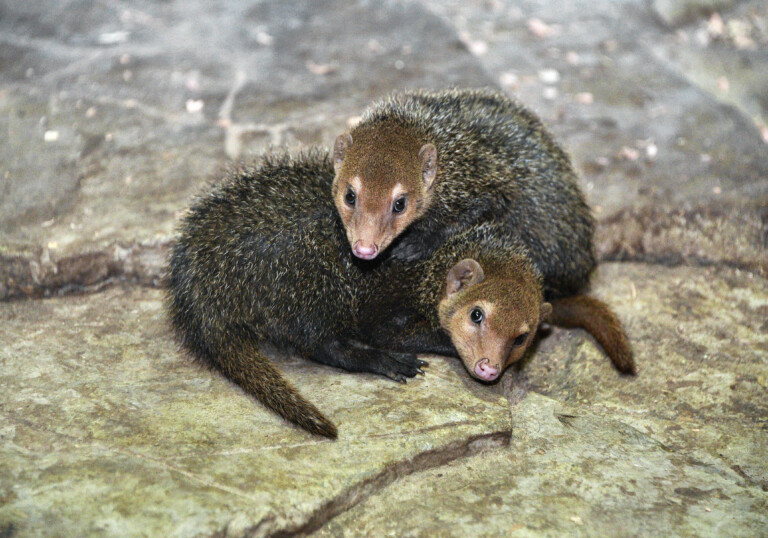
Common cusimanse
COMMON CUSIMANSE
The common cusimanse is a species native to West Africa, including Ghana, Côte d’Ivoire, Liberia,...
Детальніше
