
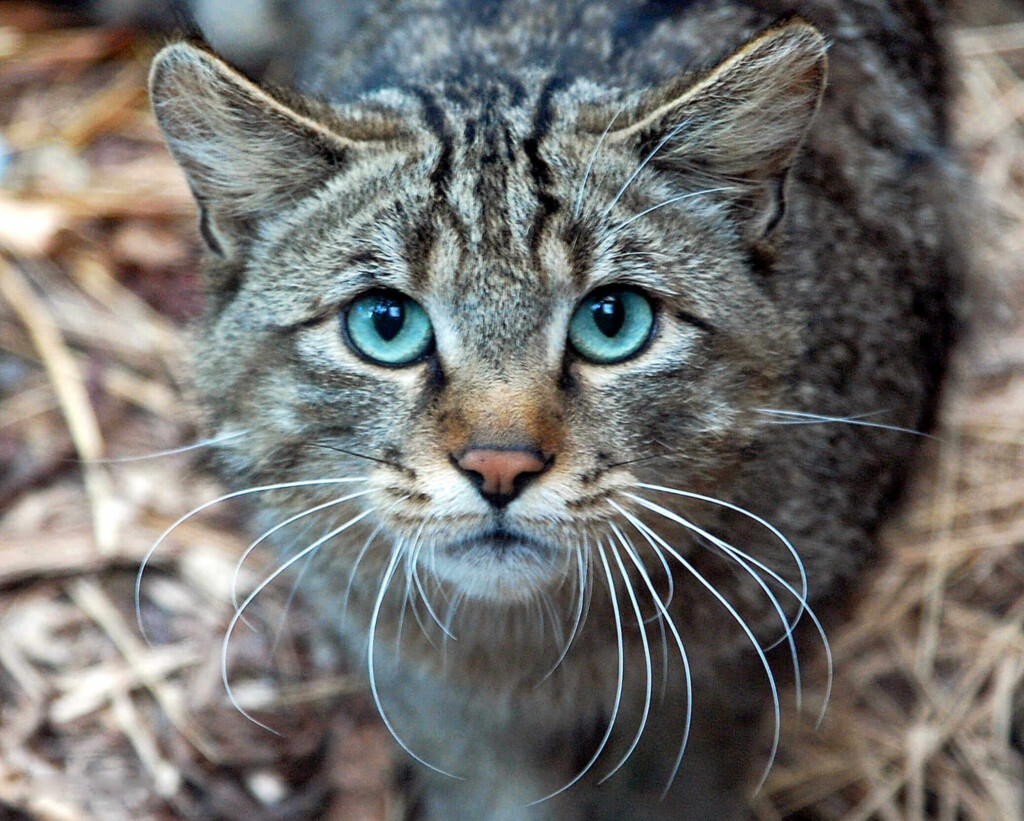
European wildcat
Felis silvestris silvestris
The European wildcat, a subspecies of the wildcat (Felis silvestris), was once widely distributed in Europe and was absent only from Scandinavia
Full Classification
Class – Mammalia (Mammals)
Order – Carnivora (Carnivores)
Family – Felidae (Cats)
Subfamily – Felinae (Small cats)
Genus – Felis (Cats)
Species – Felis silvestris silvestris
General Information
The European wildcat, a subspecies of the wildcat (Felis silvestris), was once widely distributed throughout the broadleaf and mixed forests of Europe and was absent only from Scandinavia. From the late 18th to the mid-20th century, intensive infrastructure development, industrialisation, and timber extraction in Europe resulted in a significant reduction of the species’ natural range and contributed to its fragmented distribution today.
Nevertheless, the European wildcat can adapt well to agricultural landscapes with abundant rodent populations. However, these areas also provide opportunities for hybridisation with domestic cats. Wildcats were probably domesticated approximately 9,000–10,000 years ago, coinciding with the development of agriculture and the growing need to protect crops from rodents. This hypothesis is supported by archaeological evidence.
The European wildcat is approximately the size of a large domestic cat, weighing 3–8 kg. Its body length ranges from 45 to 80 cm, with a tail approximately 30 cm long. The winter coat is thick and dense, typically greyish-brown, with distinct dark stripes on the head, neck, limbs, and tail, as well as a characteristic dark dorsal stripe.
European wildcats are solitary animals, generally active at night and during twilight and dawn. Both males and females mark their territories using scent glands located on the head and around the tail. They also rub against trees and other objects, leaving their scent and communicating information to other individuals.
Another remarkable sensory adaptation in cats is their whiskers, or vibrissae, which are highly sensitive tactile organs. Cats use their whiskers to assess whether their body can fit through narrow openings and to detect movements of nearby prey.
Gestation lasts approximately 2–2.5 months, after which the female gives birth to 1–8 kittens. European wildcats typically live for 10–15 years. Their diet consists mainly of small rodents such as mice and rats, and occasionally rabbits. They may also prey on birds, young ungulates, reptiles, amphibians, eggs, and large insects. In Ukraine, the population is estimated at approximately 400–500 individuals.
What are the main threats to European wildcats?
- Hybridisation with domestic cats;
- Loss and fragmentation of natural habitats;
- Human-related mortality, including animals being killed on roads.
The European wildcat is protected under:
- Appendix II of the CITES Convention (Convention on International Trade in Endangered Species of Wild Fauna and Flora);
- Appendix II of the Bern Convention (Convention on the Conservation of European Wildlife and Natural Habitats);
- Annex IV of the EU Habitats Directive;
- The Red Data Book of Ukraine.
The species is classified as Least Concern (LC) on the IUCN Red List of Threatened Species™.
5 Interesting facts:
- The European wildcat looks very similar to a large domestic cat, but has distinctive features such as a denser coat, a thick tail with a blunt black tip, and prominent dark stripes.
- The European wildcat has a relatively short, thick tail with several dark rings and a blunt black tip. This feature helps distinguish it from many domestic cats.
- Vibrissae, or whiskers, are highly sensitive tactile organs. They help the wildcat navigate in darkness, assess the space around its head, and detect nearby movements.
- The European wildcat is a predator specialised in hunting small prey. Its diet consists mainly of small rodents, although it may also hunt birds, amphibians, reptiles, and other small animals.
- European wildcats and domestic cats are closely related and can interbreed. Hybridisation is one of the conservation concerns for maintaining genetically distinct European wildcat populations.
