Brown-nosed coati
Nasua nasua
This species is widely distributed throughout South America, ranging from Colombia and Venezuela in the north to Uruguay and northern Argentina in the south.
Full Classification:
Class – Mammalia (Mammals)
Order – Carnivora (Carnivores)
Family – Procyonidae (Raccoons)
Genus – Nasua (Coatis)
Species – Nasua nasua
General Information:
This species is widely distributed throughout South America, ranging from Colombia and Venezuela in the north to Uruguay and northern Argentina in the south. It inhabits forested areas and can be found at elevations of up to 2,500 metres above sea level.
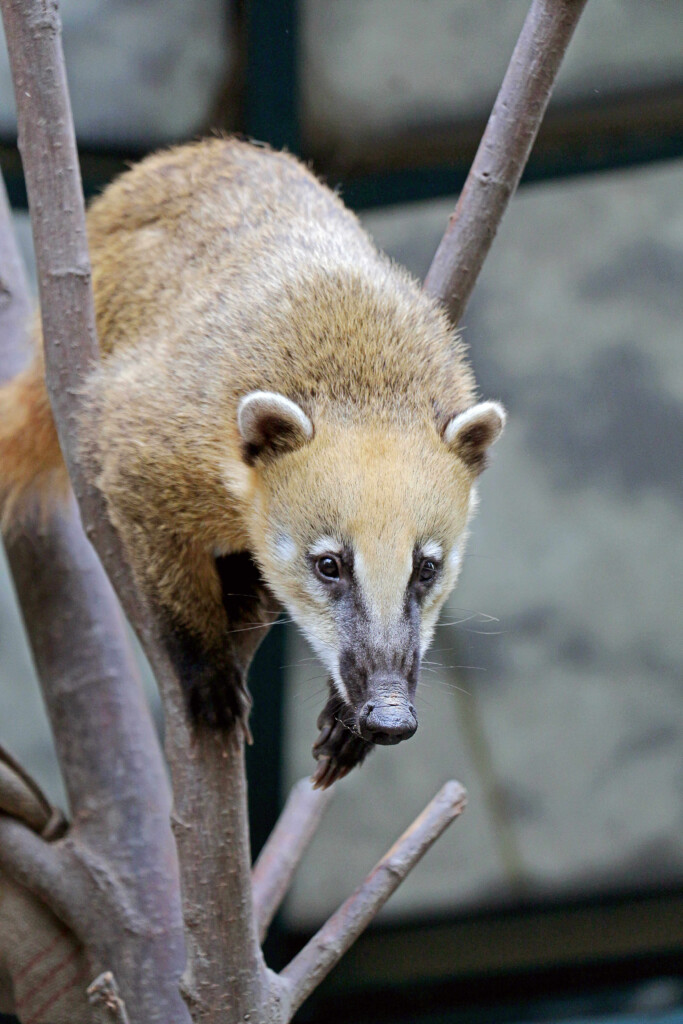
Adults measure approximately 40–70 cm from the head to the base of the tail, with the tail adding another 30–70 cm to their total length. They stand about 30 cm at the shoulder and weigh between 3 and 6 kg. Coatis have strong claws and forelimbs adapted for climbing and digging for food. Their coat ranges from dark brown and grey to reddish-brown. The head is narrow, while the nose is slightly upturned, elongated, and highly flexible, allowing coatis to search for food beneath leaf litter. Lifespan in the wild is approximately 7–8 years, while in captivity it can reach 14–15 years.
Females and young animals live in groups, while adult males are generally solitary. Coatis spend much of the day searching for food on the ground, while they sleep and build resting sites in trees. Females give birth to 2–7 young, after a gestation period of approximately 2–2.5 months.
Coatis are omnivorous. Fruits and invertebrates form the main part of their diet, but they also eat eggs, larvae, scorpions, millipedes, spiders, ants, termites, lizards, small mammals, rodents, and carrion.
What threatens coatis?
- degradation and loss of natural habitats due to deforestation;
- hunting by local communities for meat.
This species is listed in Appendix III of CITES (the Convention on International Trade in Endangered Species of Wild Fauna and Flora).
5 Interesting Facts:
1. A coati can move the tip of its nose in different directions
The coati’s long, mobile nose is highly sensitive and helps the animal locate food in the soil, beneath fallen leaves, and among vegetation. It actively explores its surroundings by constantly moving its nose from side to side.
2. Coatis are excellent climbers
Nasua nasua is well adapted to life in trees. Its strong limbs and sharp claws allow it to climb quickly, search for food, and escape danger. Coatis can also descend from trees headfirst.
3. Females live in groups, while adult males are mostly solitary
Females and young animals usually form social groups that can consist of several dozen individuals. Adult males lead a solitary lifestyle for most of the year and generally join female groups during the breeding season.
4. Its long tail helps the coati maintain balance
The coati’s long, mobile tail plays an important role when the animal moves through trees. It acts as a balancing aid, helping the animal maintain stability on branches.
5. Coatis are omnivorous and can find food almost anywhere
Nasua nasua has a highly varied diet. It feeds on fruits, seeds, invertebrates, eggs, small vertebrates, and other available food. When foraging, coatis may turn over stones, dig through leaf litter, and investigate cracks and tree hollows.