
Serval
Leptailurus serval
The serval is a medium-sized wild cat found mainly in sub-Saharan Africa.
Детальніше
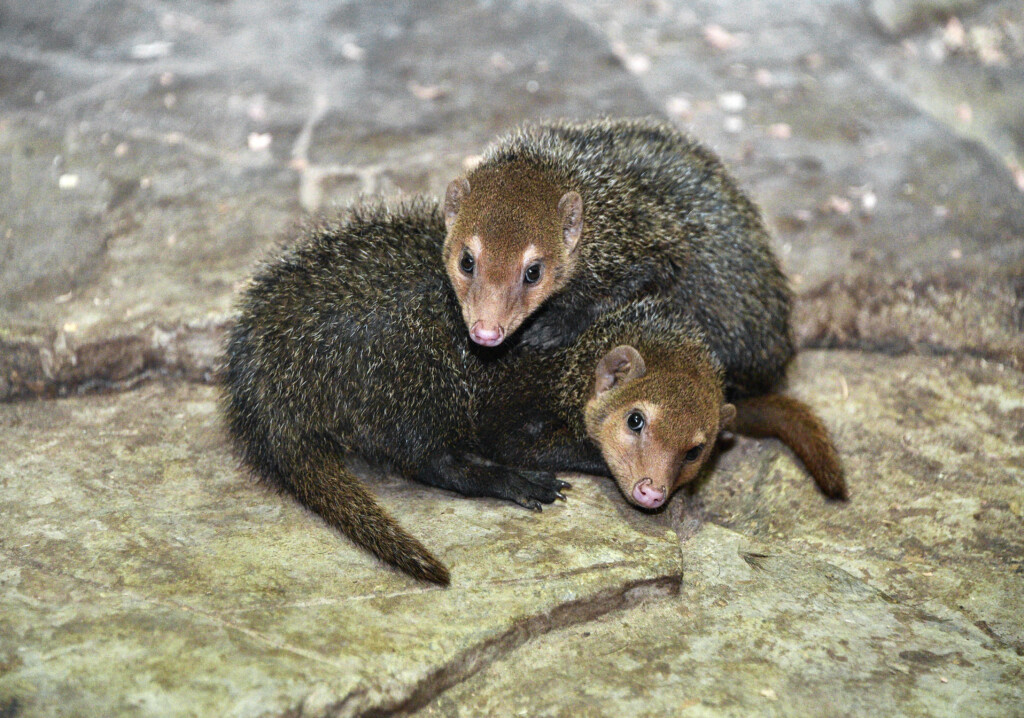
The common cusimanse is a species native to West Africa, including Ghana, Côte d’Ivoire, Liberia, Sierra Leone, and Guinea.
Class – Mammalia (Mammals)
Order – Carnivora (Carnivores)
Family – Herpestidae (Mongooses)
Genus – Crossarchus (Cusimanses)
Species – Crossarchus obscurus
The common cusimanse is a species native to West Africa, including Ghana, Côte d’Ivoire, Liberia, Sierra Leone, and Guinea. It inhabits tropical forests at elevations of up to 1,500 metres above sea level and is often found near water.
Common cusimanses are among the smallest members of the mongoose family. They have a slender body, short legs, and a short tail measuring approximately 15–21 cm, which tapers evenly from the base to the tip. Their coat is a mixture of brown, grey, and yellowish tones. Body weight ranges from approximately 300 to 800 g, while body length is 40–56 cm. They have well-developed vision and sense of smell.
Common cusimanses are highly social animals that live in groups. They communicate using a wide range of vocalizations, including barks, growls, and whistles. They are active during the day and generally do not remain in one place for long, moving around their territory in search of food. During these movements, adult members of the group take turns carrying the young. Pregnancy lasts approximately 1.5–2 months, and females give birth to 1–4 young. Their lifespan is approximately 4–7 years.
These animals are omnivorous and feed on insects, larvae, small reptiles, crabs, fruits, and berries. They find food by digging through leaf litter and soil and turning over stones and fallen branches.
Local people sometimes hunt common cusimanses for food.
These animals use a variety of vocal signals to maintain contact within the group. This is particularly important during group foraging, when individuals may spread out but still remain in communication with one another.
The cusimanse has short legs and an elongated body, allowing it to move easily through dense undergrowth, vegetation, and leaf litter. Unlike many mongooses that inhabit open landscapes, it is strongly associated with forest habitats.
